Circuit Boards Failure Inside Data Centers
Learn how dust, moisture, heat, and corrosive gases cause circuit board failures in data centers. Discover effective prevention strategies to protect hardware.
Key takeaways
- Circuit boards in data centers fail from four main environmental causes: dust, moisture, heat, and corrosive gases.
- ASHRAE guidelines recommend keeping relative humidity below 60% to prevent dust from absorbing moisture and causing corrosion.
- Creep corrosion converts exposed copper and silver into sulfides, causing short circuits or open circuit failures.
- Thermal cycling from load changes and cooling faults stresses solder joints until they eventually crack and fail.
Why Circuit Boards Fail Inside Data Centers
Circuit boards in a data center fail from four environmental causes: dust, moisture, heat and corrosive gases. Dust is often the trigger for the other three, because it traps heat, holds moisture and carries the salts and sulfur compounds that corrode copper and silver.
ASHRAE's data center contamination guidelines state the rule plainly: keep relative humidity below 60% to stop dust from corroding the hardware.
How does dust damage a circuit board?
Dust does harm in two opposite ways, depending on how wet it is.
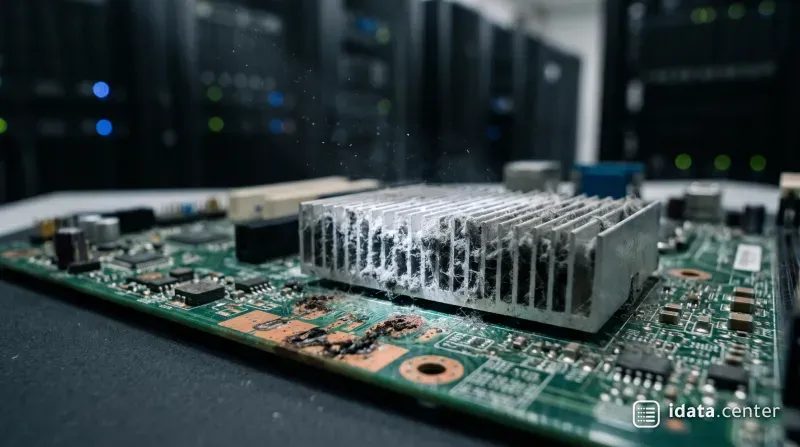
When dust is dry, it acts as an insulator. It settles on components and heat sinks, sticks to them through static charge and works like a blanket. The parts run hotter than the room temperature suggests, and they fail from overheating even when the data hall is well cooled.
When dust absorbs moisture, it becomes conductive. The ASHRAE TC 9.9 guidelines explain this with the deliquescent relative humidity: the humidity at which dust takes in enough water to become wet. Below that point the dust stays dry and does not contribute to corrosion. Above it, leakage current through the dust rises sharply, and ions can migrate between conductors.
ASHRAE sums up the effects of dust as:
- Mechanical: blocked cooling airflow, interference with moving parts, abrasion and optical interference.
- Chemical: corrosion of components where dust settles on boards.
- Electrical: impedance changes and bridging between conductors.
Why does humidity matter so much?
Humidity decides whether settled dust is harmless or active. ASHRAE notes that the corrosion rate of copper is a strong function of relative humidity, and recommends keeping the data center below 60% RH.
Server makers set limits on the dust itself. Lenovo's server documentation requires that the deliquescent relative humidity of particulate contamination is above 60% RH, so dust in the room stays dry in normal operation.
In coastal sites, salt in the air lowers that threshold. ASHRAE lists large bodies of salt water as a major source of airborne dust in data centers.
What is creep corrosion?
Creep corrosion is the slow conversion of copper on a circuit board into copper sulfide, which then spreads across the board surface. ASHRAE explains that sulfur-bearing gases and moisture attack any exposed copper. The growing corrosion product can eventually bridge neighbouring pads and cause short circuits.
Silver is affected too. Silver terminations on surface-mounted parts can turn into silver sulfide, leading to open circuits in components such as resistors.
ASHRAE links the rise in corrosion failures to two changes: the move from lead-containing to lead-free solder, and board finishes adopted to comply with the EU RoHS directive, such as immersion silver. Newer boards are more sensitive than the older ones they replaced.
To keep corrosion in check, Lenovo sets gaseous limits of less than 200 Å per month for both copper and silver reactivity, measured with corrosion coupons, and requires ISO 14644-1 Class 8 for particles. What other manufacturers require is covered in what Dell, HPE and Lenovo say about contaminated environments.
How do heat and cold cycles damage boards?
Every component and solder joint expands when it heats and contracts when it cools. Repeated cycles, from load changes, cooling faults or equipment being switched on and off, stress the solder joints until they crack. A cracked joint can work intermittently for months before it fails completely.
Dust makes this worse. A board blanketed in dust runs hotter at peak load, so each cycle is larger.
What other contaminants cause board failure?
- Zinc whiskers from older floor tiles, which can short circuits when they land on a board. See zinc whiskers and white rust.
- Insects and their remains, which can bridge live contacts and leave corrosive residue. See do insects conduct electricity.
- Fibrous dust from cardboard and packaging, which ASHRAE says can foul heat sinks. Unbox new equipment outside the data hall.
How do you prevent circuit board failure?
- Keep the room at ISO 14644-1 Class 8 with MERV 11 or MERV 13 filtration on incoming air, as ASHRAE recommends.
- Keep relative humidity below 60%, and watch it closely in coastal sites.
- Measure gaseous corrosion with copper and silver coupons if the site is near industry, traffic or the sea.
- Clean rack exteriors, blanking panels and intakes on a schedule, following cleaning active IT cabinets.
- Keep cardboard, packaging and drilling dust out of the white space.
A circuit board rarely fails from one cause. Dust, moisture, heat and gas work together, and a clean, dry, filtered room breaks that chain at the first link.
Frequently asked questions
What causes circuit board failures inside data centers?
How does dry dust damage circuit boards?
Why is relative humidity important in a data center?
What is creep corrosion?
How can circuit board failures be prevented?
Subscribe to new articles
Get new articles by email. No spam, unsubscribe any time.
© 2026 Ashraf Almuhtaseb | idata.center | All rights reserved