Post-Construction Data Center Cleaning
Learn the essential steps and ASHRAE standards for post-construction data center cleaning to prevent equipment failure before IT hardware arrives.
Key takeaways
- Post-construction data center cleaning removes dust and metal particles from hidden spaces before IT equipment arrives.
- ASHRAE TC 9.9 standards require air cleanliness of ISO 14644-1 Class 8 and a data room completely free of zinc whiskers.
- Construction dust damages IT equipment through mechanical airflow blockage, chemical corrosion, and electrical shorting.
- Cleaning must occur in phases following the trades from top to bottom and using dry methods followed by damp ones.
Post-Construction Data Center Cleaning: Steps and Standards
Post-construction data center cleaning removes the dust, debris and metal particles that building work leaves in the white space, the underfloor plenum and the ceiling void, before any IT equipment is powered on. The target is set by ASHRAE TC 9.9's 2011 Gaseous and Particulate Contamination Guidelines for Data Centers: air cleanliness of ISO 14644-1 Class 8, and a room free of zinc whiskers.
A new hall can look finished and still hold gypsum dust, drilling swarf and cardboard fibre in every hidden surface. The day the cooling units start, that dust goes wherever the air goes, including into server intakes.
What does post-construction cleaning cover?
It covers every surface the cooling air can reach, which is far more than what you see from the floor:
- Ceiling void, cable trays, cable ladders, light fittings and overhead busway
- Walls, columns, doors and frames
- Computer room air handlers (CRAH or CRAC units), ducts and return grilles
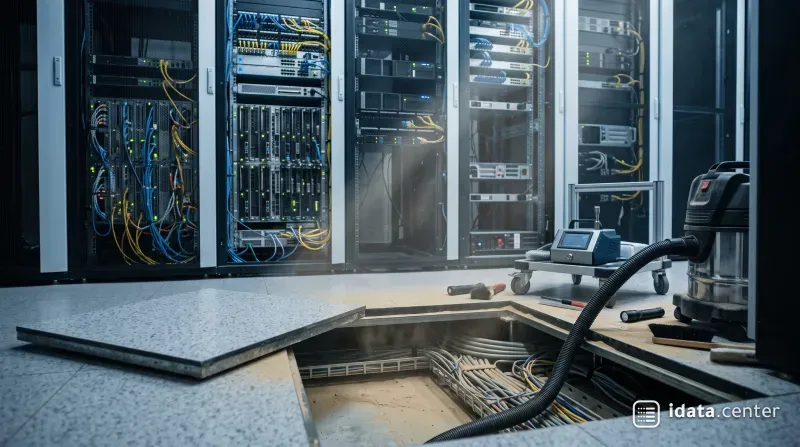
- Underfloor plenum: slab, pedestals, stringers, cabling and pipework
- Raised floor tiles, top face and underside
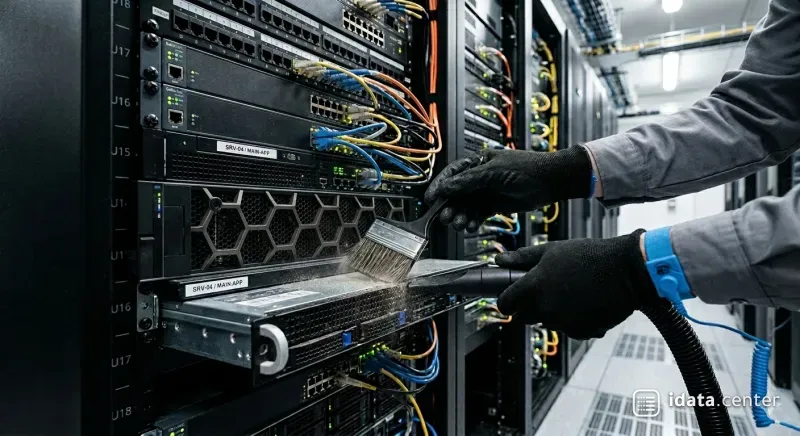
- Empty racks, cabinets, blanking panels and containment
The scope ends when IT equipment arrives. From that day the work becomes operational cleaning around live equipment, with different rules and tools.
Why is construction dust dangerous for IT equipment?
ASHRAE groups dust damage into three failure modes. Mechanical: dust blocks cooling airflow, interferes with moving parts and causes abrasion. Chemical: dust settled on circuit boards can corrode components or short closely spaced features. Electrical: dust changes impedance and bridges conductors.
Construction adds two problems of its own.
The first is fibre. ASHRAE warns that fibrous dust from paper, cardboard and textiles can foul heat sinks, and advises unboxing new equipment outside the data center.
The second is zinc whiskers. The undersides of some steel raised floor tiles, stringers and pedestals are coated with zinc, and electroplated zinc is far more prone to growing whiskers. They can reach 1 to 2 mm, and they come loose when tiles are lifted or underfloor cables are pulled, which is exactly what a fit-out does all day. ASHRAE notes that circuits above about 25 V can short, arc or fail if they ingest them.
Humidity makes settled dust worse. Dust that absorbs moisture becomes conductive, which is why ASHRAE sets a general rule of keeping data center relative humidity below 60%.
In the Gulf, location adds to the load. ASHRAE notes that sea salt can be carried 10 km or more inland by coastal winds, which matters for sites near Jeddah or Dammam. Inland, wind-blown mineral dust enters through every temporary opening left during the build. The regional picture is covered in data center cleaning in Saudi Arabia.
What cleanliness level should a new data hall reach?
ASHRAE requires ISO Class 8, judged against the 95% upper confidence limit, for data centers with or without air-side economizers. ISO 14644-1:2015 is the current edition of the classification standard. It sets these maximum concentrations for Class 8:
|
Particle size |
Maximum particles per m³ (Class 8) |
|
≥ 0.5 µm |
3,520,000 |
|
≥ 1 µm |
832,000 |
|
≥ 5 µm |
29,300 |
The counts are cumulative. The ≥ 0.5 µm figure includes every particle in the two larger sizes. How Class 8 compares with the other classes is explained in ISO 14644 cleanroom classes.
ISO Class 8 is only one part of the handover. ASHRAE's other limits for a data hall are:
|
Item |
ASHRAE limit |
How it is checked |
|
Zinc whiskers |
None present |
Debris from 10 areas on conductive tape, examined in a scanning electron microscope |
|
Room relative humidity |
Below 60% |
Room monitoring |
|
Dust deliquescent relative humidity |
Above 60% |
Laboratory test of collected dust |
|
Recirculated room air filters |
MERV 8 |
Filter specification and fitting record |
|
Air entering the data center |
MERV 11, preferably MERV 13 |
Filter specification and fitting record |
|
Copper corrosion rate |
Below 300 Å/month |
Copper coupon exposed for 30 days |
|
Silver corrosion rate |
Below 200 Å/month |
Silver coupon exposed for 30 days |
Keep one distinction in mind. An airborne particle count only measures what is in the air. ISO 14644-1 says the method cannot describe the nature of the particles, so a Class 8 result tells you nothing about the dust lying on tile undersides or in the plenum.
When should cleaning happen in the construction schedule?
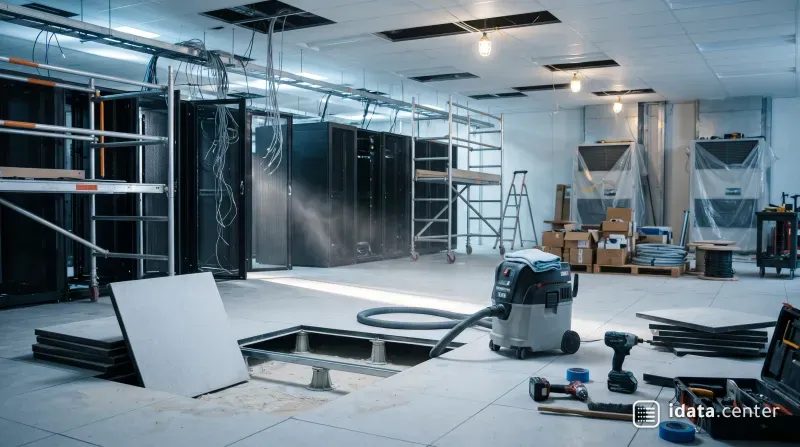
Clean in phases that follow the trades, not once at the end. A single final clean has to remove everything at once, after the cooling units have already spread it.
- Rough clean once the heavy trades (cutting, drilling, painting) finish in an area: debris and bulk dust out.
- Detailed clean of the ceiling void and underfloor plenum before the floor is closed and before the CRAH units run with the hall open.
- Final clean of floor surfaces, containment and empty cabinets before IT equipment is delivered.
- Verification tests, then handover.
Any drilling after the final clean puts you back a step, so control the dust at the source as described in drilling inside data centers. Unbox servers and switches outside the hall, as ASHRAE advises.
How is a post-construction clean done step by step?
Work from the top down and from dry methods to damp ones, so that each step does not dirty what you already cleaned.
1. Remove debris and protect the room
Take out offcuts, fixings, packaging and tools. Seal doors to corridors still under construction and set up a clean entry with shoe covers.
2. Clean the ceiling void and overhead services
HEPA-vacuum the top surfaces of cable trays, ladders, light fittings and busway, then wipe them with a damp lint-free cloth.
3. Clean walls, CRAH units and return paths
Vacuum and wipe walls, columns and frames. Clean CRAH casings, coil access panels and return grilles before the units run for long periods.
4. Clean the underfloor plenum
Lift tiles in sections, HEPA-vacuum the slab, pedestals, cables and pipework, then damp-wipe. This is where most construction debris settles, and where zinc whiskers are disturbed, so handle lifted tiles gently.
5. Clean the floor tiles and stringers
Clean both faces of each tile and the stringers before the tile goes back. Vacuum the top face, then mop with a damp, not wet, mop.
6. Clean racks and cabinets before installation
Vacuum and wipe empty cabinets, doors, cable managers and blanking panels, inside and out. This is the last chance to clean them with nothing powered inside.
7. Replace construction-phase filters
Filters that ran during the build are loaded with construction dust. Replace them to the ASHRAE grades in the table above before the handover tests.
How do you prove the room is clean before handover?
Ask for test results, not a walk-through.
- Particle counts: ISO 14644-1 bases classification on a light-scattering airborne particle counter at designated sampling locations. [VERIFY: the number of sampling locations for the hall's floor area from ISO 14644-1:2015, Annex A.] Compare the results with the Class 8 table above.
- Zinc whiskers: ASHRAE's quick check is a flashlight held at 45° across the underside of a lifted tile in a dim area. Twinkling specks suggest whiskers. Confirmation means collecting debris from 10 areas on 1.5 cm conductive tape and examining it in a scanning electron microscope.
- Corrosion: copper and silver coupons are exposed for 30 days, about 5 cm in front of the rack air inlet at one-quarter and three-quarter frame height. Run this once the cooling is operating, because ASHRAE notes that readings without airflow come out lower.
ASHRAE also asks that equipment sits in the recommended environment for at least one day before it is powered on.
Before you sign the handover
Treat cleanliness as a commissioning test with a pass mark, like cooling and power. Ask for Class 8 particle counts, a zinc whisker check and the filter change record before the first server arrives. A hall that starts clean is far easier to keep clean than one that starts with construction dust already in the plenum.
Note: you can download the attached check list file
Frequently asked questions
What is post-construction data center cleaning?
What cleanliness standards must a new data hall reach?
Why is construction dust dangerous for IT equipment?
When should cleaning take place in the construction schedule?
How is a post-construction clean performed step by step?
Download the file
Subscribe to new articles
Get new articles by email. No spam, unsubscribe any time.
© 2026 Ashraf Almuhtaseb | idata.center | All rights reserved