Can Normal Janitors Do a Cleaning Inside Data Center?
Learn why regular janitors cannot safely clean data centers and discover the specialized technical skills and ESD controls required to protect sensitive IT equipment.

Key takeaways
- Regular janitors should not clean inside a data hall without specialized training due to risks like dust, moisture, and static.
- Data halls must meet ISO 14644-1 Class 8 standards because cooling systems rapidly draw airborne dust directly into server equipment.
- Untrained cleaners risk damaging IT hardware by using incorrect tools, hazardous household products, and lacking ESD awareness.
- Data center cleaning requires specific skills in contamination control, ESD safety, approved HEPA tools, and strict site rules.
Can Regular Janitors Clean Inside a Data Center?
No. A regular janitor should not clean inside a data hall unless they have been trained for that environment. Even ASHRAE's data center contamination guidelines, when they discuss zinc whisker remediation, point owners toward hiring professionals to clean the data center.
The reason is not that janitorial work is careless. It is that the habits that make an office clean, such as damp mopping, spray-and-wipe and an upright vacuum, are the same habits that put dust, moisture and static into live IT equipment.
What makes a data hall different from an office?
A data hall is held to ISO 14644-1 Class 8, the level set in the ASHRAE TC 9.9 particulate guidelines. The cooling system moves huge volumes of air through every server, so any dust lifted by cleaning ends up at the equipment intakes within minutes.
ASHRAE lists what that dust does: it blocks cooling airflow, interferes with moving parts, causes corrosion when it settles on circuit boards and can bridge electronic conductors. Cleaning done the wrong way adds to all four.
Why are untrained cleaners a risk?
The common problems fall into four groups:
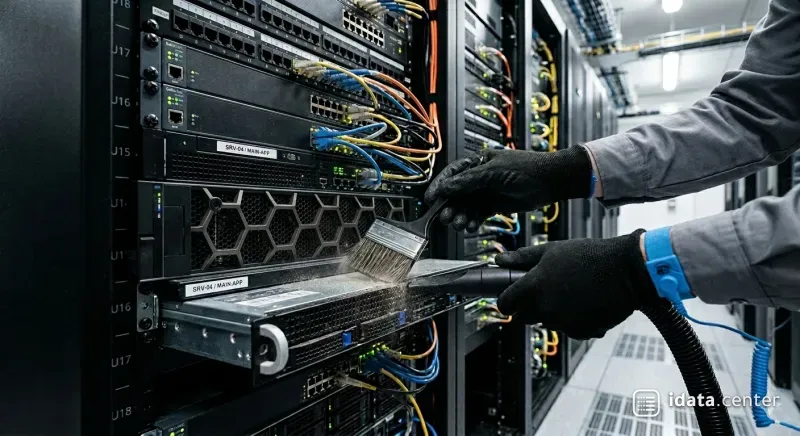
- Wrong tools. A standard vacuum blows fine dust back out through its exhaust. Ordinary cloths and brooms shed fibres and generate static.
- Wrong products. Household cleaners can be conductive, leave residue or release vapours near intakes.
- No ESD awareness. The ANSI/ESD S20.20 standard is written for parts that can be damaged by a discharge of 100 volts on the human body model. A person walking across a floor can carry far more than that without feeling it.
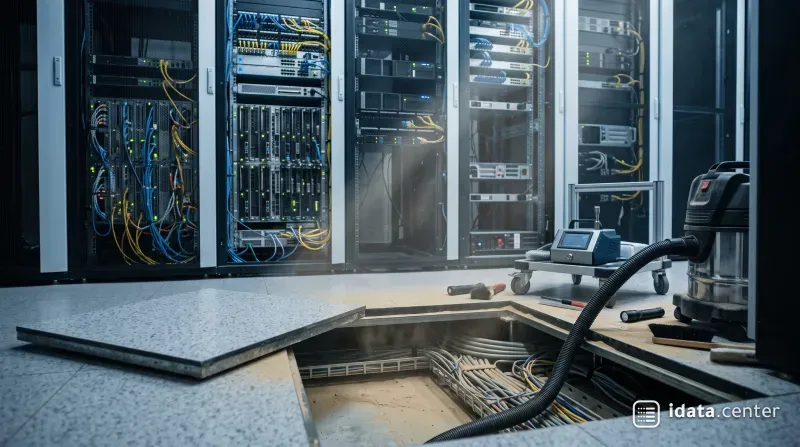
- No sense of the room. Lifting the wrong floor tile, unplugging a cleaning machine from a rack outlet, or blocking a perforated tile with a mop bucket all affect a live room.
What skills does a data center cleaner need?
|
Skill |
What it covers |
|
Contamination control |
How dust moves with the cooling air, ISO 14644-1 Class 8, why work goes from top to bottom and clean to dirty |
|
ESD awareness |
Wrist straps, ESD footwear and garments, ESD-safe tools, never touching components |
|
Tools and products |
HEPA vacuums, lint-free wipes, approved cleaning liquids, no compressed air near live equipment |
|
Site rules |
Permits, escorts, access control, which areas are off limits |
|
Floor and ceiling work |
Safe tile lifting, working in the plenum and ceiling void, working at height |
|
Reporting |
Recording what was cleaned, what was found and what needs attention |
The ESD side is explained in what is ESD cleaning in data centers, and the clothing in what to wear for technical cleaning.
Who should do the work?
There are two sound options.
A trained specialist team
A team that works only in data centers and cleanrooms brings the tools, the method and the test equipment. Ask for their training records, their method statement and a sample ISO 14644-1 test report before you award the work.
Trained in-house staff
If you prefer your own people, train them properly, give them the right equipment and supervise them. Write a site standard operating procedure (SOP) that names the tools, products, sequence and no-go areas, and make the training part of the site induction.
Whichever option you choose, the site should still control the work: a permit for each visit, an escort or supervisor from the data center team, an agreed list of areas and racks, and a short report at the end of each shift. Good teams welcome these rules, because they protect the cleaner as much as the equipment.
What can regular janitors still do?
Quite a lot, outside the white space. Corridors, offices, toilets, the loading dock and the approach to the data hall are normal janitorial areas. Keeping them clean reduces what reaches the entrance mats.
Inside the data hall, they can help under supervision with non-technical tasks such as emptying bins outside the room or restocking shoe covers. They should not clean racks, lift tiles or work in the plenum.
The bottom line
Data center cleaning is a technical job. It needs trained people, HEPA tools, ESD control and a written method. The cost of getting it wrong is described in why cleaning your data center is not optional, and the different scopes of work in types of data center cleaning.
Keep your janitorial team for the building. Give the white space to people trained for it.
Frequently asked questions
Can regular janitors clean inside a data center?
Why are untrained cleaners a risk in a data hall?
What standards must a data hall maintain for cleanliness?
What skills do data center cleaners need?
What areas can regular janitors clean?
Subscribe to new articles
Get new articles by email. No spam, unsubscribe any time.
© 2026 Ashraf Almuhtaseb | idata.center | All rights reserved