The Strategic Role of HEPA Vacuum Cleaners inside Data Centers
Learn the strategic roles of HEPA and backpack vacuums in data centers to prevent contamination, protect hardware, and ensure uptime through maintenance.
Key takeaways
- A HEPA vacuum cleaner is the basic tool of data center cleaning because it captures fine dust instead of blowing it back into the air.
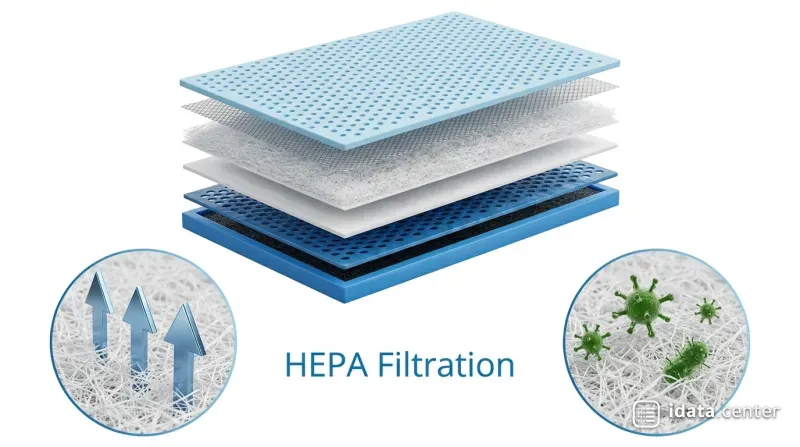
- A true HEPA filter catches at least 99.97% of particles of 0.3 micrometres, the size that is hardest for a filter to stop.
- The US Department of Energy's HEPA filter specification, DOE-STD-3020, requires a minimum efficiency of 99.97% when tested with an aerosol of 0.3 micrometre diameter.
- Many professional vacuums use a pre-filter and a main filter before the HEPA stage.
The Role of HEPA and Backpack Vacuum Cleaners Inside Data Centers
A HEPA vacuum cleaner is the basic tool of data center cleaning because it captures fine dust instead of blowing it back into the air. A true HEPA filter catches at least 99.97% of particles of 0.3 micrometres, the size that is hardest for a filter to stop.
Dust and particulate contamination are a constant threat to IT equipment, leading to overheating, component failure and unplanned downtime. Cleaning is part of preventive maintenance and risk reduction, and doing it with precision and safety depends on the right equipment.
A standard vacuum lets fine particles pass through its filter and out of its exhaust. A HEPA vacuum traps them. This article explains the different and complementary roles of two tools: the stationary HEPA vacuum for large areas, and the backpack vacuum for network cabinets and hard-to-reach places.
What does "HEPA" actually mean?
HEPA stands for high-efficiency particulate air. The US Department of Energy's HEPA filter specification, DOE-STD-3020, requires a minimum efficiency of 99.97% when tested with an aerosol of 0.3 micrometre diameter. Particles both larger and smaller than 0.3 µm are caught even more easily, which is why that size is used for testing. If µm is new to you, see what does µm mean.
For data center work, choose a vacuum with an H13 or H14 filter and a sealed housing. A good filter in a leaky body lets dust escape around it.
Single-stage and multi-stage machines
Many professional vacuums use a pre-filter and a main filter before the HEPA stage. The earlier stages catch coarse dust, so the HEPA filter stays efficient for longer and the exhaust stays clean.
The stationary HEPA vacuum: the base of environmental control
The main defence against airborne contamination in a data center is a vacuum with a HEPA filter. Built for raised floors, surrounding areas and general surfaces, these machines are the backbone of data center cleanliness.
Main job: capturing fine particles, including dust, fibres and skin flakes, that would otherwise clog server fans and affect hardware performance.
Key uses:
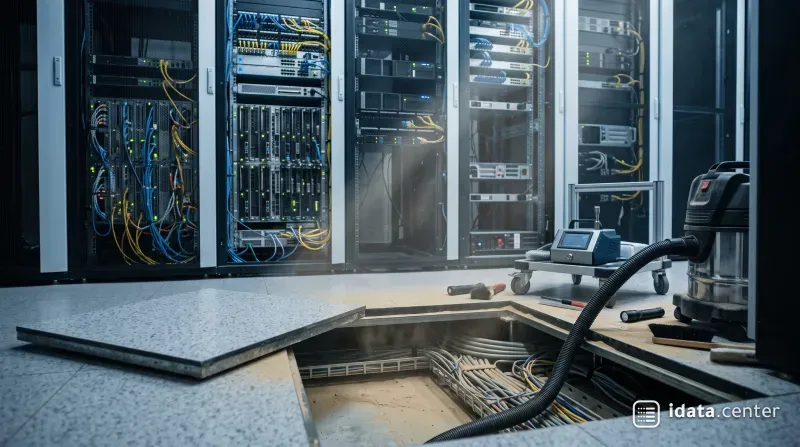
- Underfloor vacuuming: removing debris that blocks airflow and can become a fire risk. The method is in raised floor tile cleaning.
- Raised floor maintenance: cleaning around network cabinets and walkways without disturbing live equipment.
- Airborne contamination control: the exhaust air leaves cleaner than the room air, so dust is not recirculated.
The backpack vacuum: agility and precision for IT racks
While the stationary vacuum handles the wider room, cleaning live network cabinets and hard-to-reach areas needs a different tool: the professional backpack vacuum.
This hands-free system gives freedom of movement. Technicians can move through narrow hot and cold aisles, reach overhead cable trays and clean around dense cabling with little risk of disturbance.
Key uses:
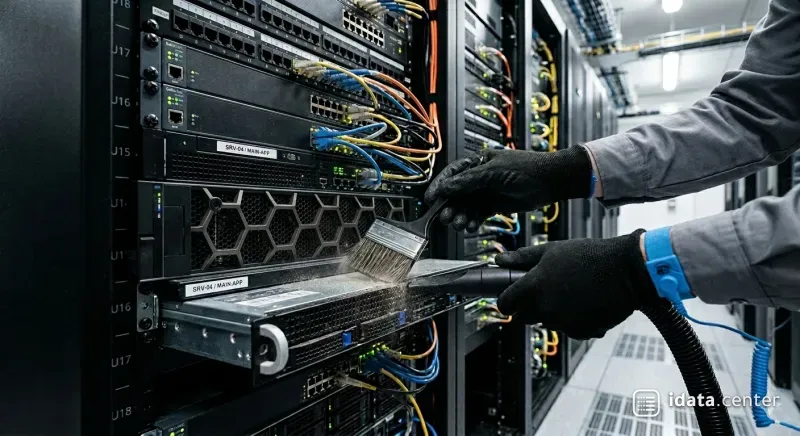
- In-rack cleaning: removing dust from server faces, blanking panels, PDUs and the back of racks where cables collect. The full method is in cleaning active IT cabinets.
- Remote and enclosed areas: corners, overhead cable trays and side rooms that a large machine cannot reach.
- Spot cleaning during upgrades: quick cleaning during equipment replacement or installation, without pushing a large machine down a crowded aisle.
Safety and operating protocol
Working close to live IT equipment needs care. Technicians using backpack vacuums should follow a strict protocol:
- ESD protection: the vacuum and the operator should be grounded, and anti-static hoses, wands and brushes must be used. See what is ESD cleaning in data centers.
- Awareness of surroundings: stay aware of everything nearby to avoid knocking cables, switches or power cords. The two-person rule is recommended for sensitive areas: one person cleans while the other watches and guides.
- Tool control: use soft-bristled brushes and slotted tools made for electronics, so components and connectors are not damaged.
- Procedure compliance: always follow the data center's ticketing and access procedures, so security and operations know the work is happening.
- Experienced hands for live equipment: an experienced technical engineer, or someone with similar experience, should be responsible for cleaning active equipment inside network cabinets. Avoid assigning this to technicians with little or no experience.
A two-tier cleaning strategy
A sound data center cleaning plan uses both machines. The stationary HEPA vacuum controls the wider environment, managing large-scale contamination and air quality. The backpack vacuum works like a precision tool, allowing careful, non-invasive cleaning of the most important assets: the live equipment inside the cabinets.
Investing in this equipment, and even more in technicians trained to use it safely, is an investment in data center resilience. It lowers the risk of contamination-related failures, supports good thermal management and protects the operations inside. In a tightly controlled data center, the right tool for the job is a basic requirement.
Frequently asked questions
What is a HEPA vacuum cleaner and why is it used in data centers?
What does HEPA stand for and what is its minimum efficiency?
What is the main role of a stationary HEPA vacuum?
When should a backpack vacuum be used in a data center?
What safety protocols should be followed when using vacuums near live IT equipment?
Subscribe to new articles
Get new articles by email. No spam, unsubscribe any time.
© Ashraf Almuhtaseb | idata.center. Short quotes are welcome with credit and a link to this article. Republishing the full article requires written permission.