Particle Sizes in Data Center Air: What Does µm Mean?
The term µm stands for micrometer, which is a unit of length in the metric system. It is equivalent to one-millionth of a meter or one-thousandth of a millimeter
Key takeaways
- The symbol µm stands for micrometre or micron, which equals one millionth of a metre.
- The ISO 14644-1 test for data hall ISO Class 8 compliance counts particles of 0.5 µm and 5 µm and larger.
- ASHRAE TC 9.9 contamination guidelines require data centers to maintain cleanliness up to ISO 14644-1 Class 8.
- Data center cleaning uses HEPA vacuums because fine dust around 0.5 µm stays airborne and passes through ordinary filters.
What Does µm Mean? Particle Sizes in Data Center Air
The symbol µm stands for micrometre, also called micron. One micrometre is one millionth of a metre, or one thousandth of a millimetre (1 µm = 0.001 mm = 10⁻⁶ m).
In data center cleaning, µm is the unit used for airborne particles. The ISO 14644-1 test that shows whether a data hall meets ISO Class 8 counts particles of 0.5 µm and larger and, usually, 5 µm and larger.
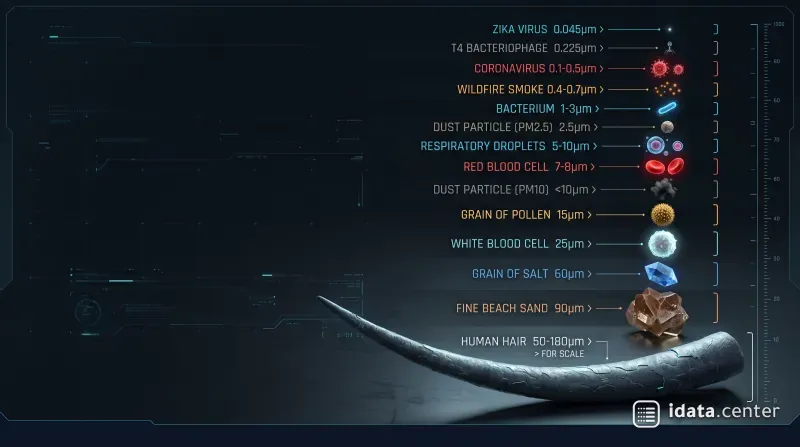
How small is a micrometre?
It helps to compare it with things you know. The US Environmental Protection Agency gives the average human hair as about 70 micrometres in diameter. A 0.5 µm particle is therefore about 140 times thinner than a hair, far below what the eye can see.
|
Item |
Typical size |
|
Human hair (average diameter) |
About 70 µm |
|
Sand and large dust |
Larger than 10 µm |
|
PM10, inhalable particles |
10 µm and smaller |
|
PM2.5, fine particles |
2.5 µm and smaller |
|
Larger ISO 14644-1 size in a data hall test |
5 µm |
|
Main ISO 14644-1 size in a data hall test |
0.5 µm |
|
Smallest size covered by ISO 14644-1 classes |
0.1 µm |
The sand, PM10 and PM2.5 figures are also from the EPA's particulate matter basics. The ISO sizes come from ISO 14644-1:2015.
Where else is µm used?
- Science and engineering: to measure cells, bacteria and other tiny structures.
- Cleanrooms and data centers: to state the size of particles counted in air cleanliness tests.
- Manufacturing: to set tolerances on precision parts.
- Medicine: to describe microorganisms, implants and fine surgical tools.
Why do 0.5 µm and 5 µm matter in a data center?
ASHRAE's TC 9.9 contamination guidelines state that data centers must be kept clean to ISO 14644-1 Class 8. That class sets limits at three sizes:
|
Particle size |
ISO Class 8 limit (particles per m³) |
|
0.5 µm and larger |
3,520,000 |
|
1 µm and larger |
832,000 |
|
5 µm and larger |
29,300 |
The 0.5 µm channel captures the fine fraction that stays airborne and travels with the cooling air into every server. The 5 µm channel captures larger dust, the part that settles on heat sinks, fans and boards. Testing at both sizes shows whether the room is clean in the air and whether coarse dust is still being stirred up.
Note that the limits are cumulative. "0.5 µm and larger" includes all the 1 µm and 5 µm particles too. The full class table is in ISO 14644 cleanroom classes.
What do the sizes mean for cleaning?
Particle size decides which tools work.
- Visible dust, on floors and tops of racks, is the coarse end. It is easy to see, but if you sweep or blow it, the fine fraction inside it goes airborne.
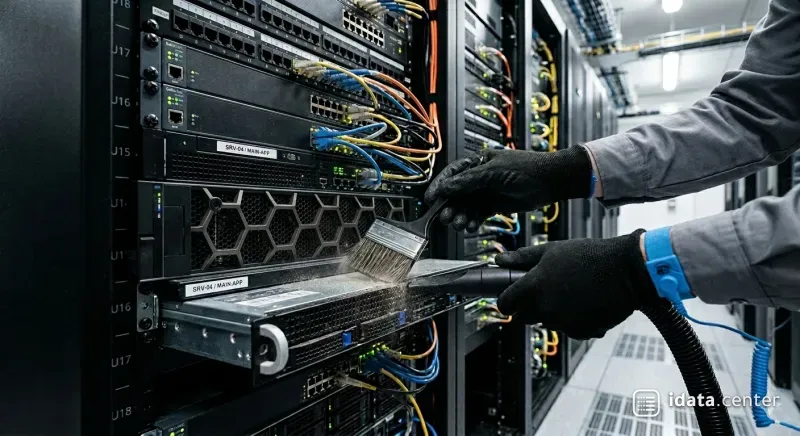
- Fine dust around 0.5 µm stays in the air for a long time and passes through ordinary vacuum filters. That is why data center cleaning uses HEPA vacuums, which are tested on very small particles. See HEPA vacuums inside data centers.
- Fibrous dust from cardboard and textiles is large but light. ASHRAE warns that it can foul heat sinks.
How does particle size relate to air filters?
Filters are also rated by how well they catch particles of a given size. ASHRAE recommends MERV 8 filters for air that recirculates inside the data hall, and MERV 11 or, preferably, MERV 13 for air entering from outside. The higher the MERV rating, the better the filter catches particles in the low micrometre range.
This matters most in dusty regions. much desert dust is fine enough to pass a weak filter and reach the servers. A poor or badly fitted filter on the fresh-air intake lets in exactly the sizes that the ISO test counts.
How are particles measured in µm?
An optical particle counter draws a known volume of air past a laser and sizes each particle by the light it scatters. It sorts them into size channels, such as 0.3, 0.5, 1 and 5 µm. Choosing the right counter is covered in which particle counter to use, and the number of test points in sample locations for ISO 14644-1.
A micrometre is tiny, but in a data hall it is the unit that matters most. The particles you cannot see are the ones your servers breathe.
Frequently asked questions
What does µm stand for?
Why are 0.5 µm and 5 µm particle sizes important in data centers?
What filter ratings does ASHRAE recommend for data center air?
How are airborne particles measured in micrometres?
Why are HEPA vacuums needed for cleaning data centers?
Subscribe to new articles
Get new articles by email. No spam, unsubscribe any time.
© Ashraf Almuhtaseb | idata.center. Short quotes are welcome with credit and a link to this article. Republishing the full article requires written permission.