ISO 14644: Cleanroom Classes
Learn what ISO 14644-1 cleanroom classes mean for data centers, why ASHRAE recommends Class 8, and how testing protects server hardware from dust and heat.
Key takeaways
- ASHRAE recommends ISO 14644-1 Class 8 for data centers, allowing no more than 3,520,000 particles of 0.5 µm or larger per cubic metre.
- ISO 14644-1 measures airborne particle concentration only and does not evaluate surface dust, settled debris, or corrosive gases.
- Since the 2015 edition of the standard, every sampling location must be at or below the class limit for the room to pass.
- A 1,000 m² data hall requires a minimum of 27 sampling locations determined by Annex A of the ISO 14644-1 standard.
ISO 14644-1 Cleanroom Classes: What They Mean for Data Centers
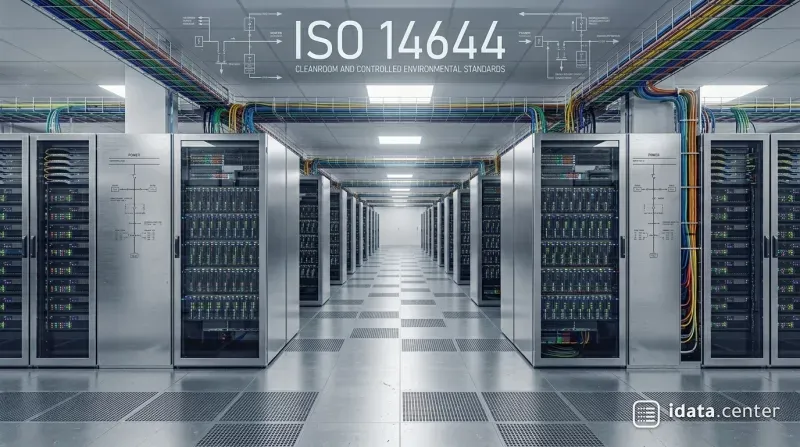
ISO 14644-1 is the international standard that grades how clean the air in a room is, by counting the particles in each cubic metre. For data centers, ASHRAE recommends ISO 14644-1 Class 8: no more than 3,520,000 particles of 0.5 µm or larger in each cubic metre of air.
That sounds like a lot of particles. It is a very small amount of dust by weight, and a data hall that looks clean can still fail it. The gap between "looks clean" and "measures Class 8" is where many cooling and hardware problems start.
What does ISO 14644-1 measure?
The full title is ISO 14644-1:2015, Cleanrooms and associated controlled environments, Part 1: Classification of air cleanliness by particle concentration. The 2015 edition replaced the original 1999 version.
The standard counts airborne particles from 0.1 µm to 5 µm with an optical particle counter. Rooms are graded from ISO Class 1, the cleanest, to ISO Class 9. Each class allows ten times more particles than the class before it. If the unit is new to you, see what µm means.
Three points are often misunderstood:
- It measures air only. It says nothing about dust lying on surfaces, inside equipment or under the raised floor.
- It counts particles, not gases. Corrosive gases need a different test.
- A class is a limit, not a description. A Class 8 room is one that measured at or below the Class 8 numbers on the day of the test.
What are the ISO 14644-1 class limits?
The table shows the maximum number of particles allowed per cubic metre of air, for particles at or above each size. The counts are cumulative: the 0.5 µm column includes every larger particle too.
|
ISO class |
≥ 0.5 µm |
≥ 1 µm |
≥ 5 µm |
Typical use |
|
ISO 5 |
3,520 |
832 |
– |
Sterile filling, semiconductor process zones |
|
ISO 6 |
35,200 |
8,320 |
293 |
Precision electronics and optics assembly |
|
ISO 7 |
352,000 |
83,200 |
2,930 |
Pharmaceutical support areas, medical device assembly |
|
ISO 8 |
3,520,000 |
832,000 |
29,300 |
Data centers (ASHRAE recommendation) |
|
ISO 9 |
35,200,000 |
8,320,000 |
293,000 |
Close to ordinary indoor air |
You will still hear the old US names from FED-STD-209E, which was cancelled in 2001. ISO 5 was "Class 100", ISO 7 was "Class 10,000" and ISO 8 was "Class 100,000".
Why do data centers use ISO Class 8?
The recommendation comes from the ASHRAE TC 9.9 Gaseous and Particulate Contamination Guidelines for Data Centers. It asks for data halls to be kept at ISO 14644-1 Class 8, with room air filtered continuously through MERV 8 filters and outside air brought in through MERV 11 or, preferably, MERV 13 filters.
The reasons are practical. Anyone who has opened a server after a few years in a dusty room has seen them:
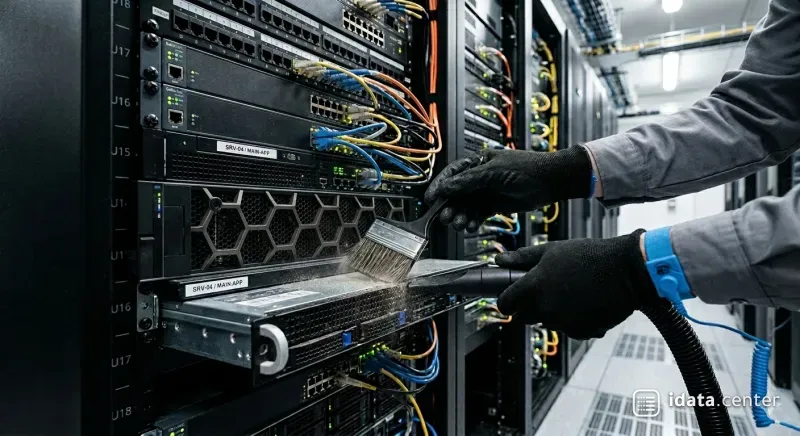
- Heat. Fine dust coats heat sinks, fan blades and filters. Components run hotter, and fans spin faster to make up for it.
- Short circuits. Conductive particles, such as metal swarf from drilling or zinc whiskers from old floor tiles, can bridge circuits on a board.
- Moisture. Some dust absorbs water from the air and becomes conductive. ASHRAE asks that dust in a data center only becomes damp above 60% relative humidity.
- Connectors and media. Fibre connectors and tape drives are very sensitive to fine particles.
Server manufacturers tie their own requirements to the same level. What Dell, HPE and Lenovo write about it is covered in what server manufacturers say about contaminated environments.
How is an ISO 14644-1 test done in a data hall?
- Agree the occupancy state. The standard defines three: as-built, at-rest and operational. Write the state on the report, because results from different states cannot be compared. The timing after cleaning is covered in when to take the ISO 14644 reading.
- Work out the sampling locations. Annex A of the standard sets the minimum number by floor area. A 1,000 m² data hall needs at least 27. The full table is in how many sample locations ISO 14644-1 requires.
- Take the samples. Use an optical particle counter calibrated to ISO 21501-4. At each location, sample at least 2 litres of air for at least one minute, and record at least the 0.5 µm and 5 µm channels. Choosing the device is covered in which particle counter to use.
- Check the result. Since the 2015 edition, every location must be at or below the class limit for each size measured. One location over the limit means the room does not meet Class 8. Treat it as a maintenance finding and look for the source: an open tile, a damaged filter, a door seal or recent work nearby.
- Keep the report. It should show the date, the occupancy state, the counter's serial number and calibration date, a map of the sampling points, the counts at each point and the result. This is the document an auditor, a client or a hardware vendor will ask for.
How often should a data hall be tested?
A sensible schedule for a data hall:
- At least once a year, as a baseline.
- Before and after a deep cleaning, to prove the result.
- After construction, drilling or tile cutting in or near the white space.
- After a dust storm, if outside air, room pressure or door discipline was affected.
- When filters are replaced, or when failures that point to dust start to appear.
In Saudi Arabia and the Gulf, the dust storm point matters more than in most places. Fine desert dust finds every gap in a door seal. Local conditions are covered in data center cleaning in Saudi Arabia.
What does ISO Class 8 not cover?
Passing the air test is not the whole picture.
- Gases. Sulphur and chlorine compounds corrode copper and silver on circuit boards. ASHRAE measures this with copper and silver coupons and asks for corrosion below 300 Å per month on copper and below 200 Å per month on silver.
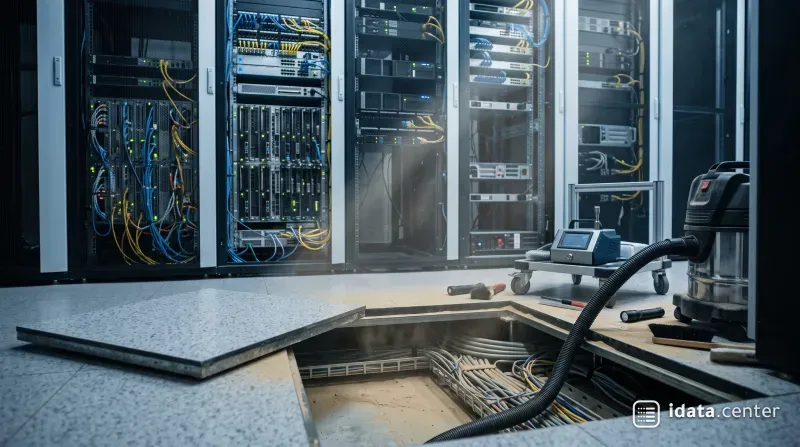
- Settled dust. A room can pass the air test while the plenum holds years of dust. The first time someone lifts a row of tiles, it goes straight into the cold air. See raised floor tile cleaning.
- Zinc whiskers. They are few in number and up to a few millimeters long, so a normal particle count does not catch them. They are found by inspecting floor tiles, pedestals and stringers.
ISO 14644-1 Class 8 is the minimum for a data hall, not a stretch goal. Measure it with a calibrated counter, keep the report, and treat every location over the limit as a work order. Combined with regular surface and plenum cleaning, it is one of the simplest ways to protect the hardware the business depends on.
Frequently asked questions
What is ISO 14644-1?
What ISO class does ASHRAE recommend for data centers?
What does the ISO 14644-1 air test fail to cover?
How many sampling locations are needed for an ISO 14644-1 test in a data hall?
How often should a data hall be tested according to the article?
Subscribe to new articles
Get new articles by email. No spam, unsubscribe any time.
© Ashraf Almuhtaseb | idata.center. Short quotes are welcome with credit and a link to this article. Republishing the full article requires written permission.