Zinc Whiskers and White Rust Inside Data Centers
Learn how conductive zinc whiskers on raised floors cause server short circuits and how to inspect, clean, and replace contaminated data center hardware safely.
Key takeaways
- Zinc whiskers are electrically conductive metal filaments that grow from zinc-plated steel surfaces and can cause short circuits in data center equipment.
- Whiskers typically grow on the underside of raised floor tiles, pedestals, and racks, often breaking loose during maintenance to be circulated by cooling air.
- A definitive diagnosis for zinc whiskers involves collecting surface debris on sticky conductive tape and examining it under a scanning electron microscope.
- White rust is a chalky corrosion product that forms on zinc surfaces exposed to moisture and should be removed with a HEPA vacuum to prevent contamination.
Zinc Whiskers and White Rust in Data Centers
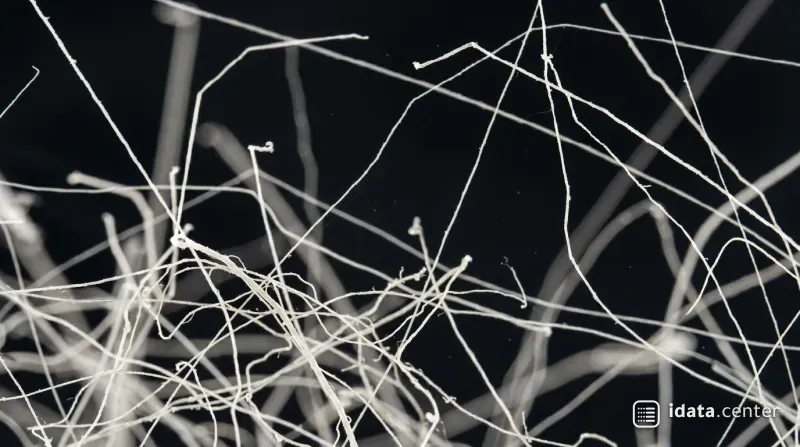
Zinc whiskers are hair-thin metal filaments that grow out of zinc-plated steel, most often on the underside of older raised floor tiles and their supports. They are electrically conductive, and once they break loose and get into a server, they can short a power supply.
NASA's Goddard Space Flight Center has documented whiskers longer than 2 mm on floor tiles from a computer room more than 20 years old. Debris from those tiles was spread by the cooling air and reached servers and routers, causing short circuits.
What are zinc whiskers?
A whisker is a single crystal of metal that slowly grows out of a plated surface. NASA's zinc whisker awareness paper describes them as usually a few millimetres long or less and a few microns thick, growing at up to about 1 mm a year after a delay that can last months or years.
Do not confuse them with tin whiskers. Tin whiskers grow on tin-plated parts, such as component leads and connectors. Zinc whiskers grow on zinc-plated steel. Both are conductive, but in a data hall the large surfaces at risk are zinc.
Where do zinc whiskers grow in a data center?
NASA's reports describe whiskers on electroplated zinc. The places most often reported are:
- The steel underside of raised floor tiles.
- Floor pedestals and stringers.
- Racks, cabinets and chassis.
- Small hardware such as nuts, screws and washers.
The risk is highest in older facilities with original floor systems. If your tiles have a different finish, ask the floor manufacturer what coating was used.
How do whiskers get into servers?
While a whisker stays attached, it does little harm. The problem starts when it breaks off.
Lifting, sliding or replacing floor tiles, pulling cables under the floor and installing overhead trays all knock whiskers loose. The cooling air then lifts them out of the plenum, through perforated tiles and into equipment intakes. This is why any work under the floor, including drilling inside data centers, needs dust control.
Inside the equipment, a whisker can bridge two conductors. NASA explains that at low available current the short can be permanent, while at higher current the whisker melts and the fault is intermittent and hard to trace. Power supplies are the most reported failure. Whiskers can also jam moving parts or cover optical sensors.
How do you check a floor tile for whiskers?
NASA describes a simple first check:
- Choose tiles away from sensitive equipment that have not been lifted recently.
- Lift the tile gently and lay it metal side up. Metal side down crushes the whiskers.
- Dim the room lighting if you can.
- Shine a bright flashlight across the surface, parallel to it, and look along the surface from the same low angle.
- Look for a sparkling or dust-like texture.
This visual check can miss whiskers. For a firm answer, use the method in Lenovo's server documentation: surface debris is collected from 10 areas of the data center on a 1.5 cm disk of sticky conductive tape and examined under a scanning electron microscope. If no whiskers are found, the data center is considered free of them. Lenovo states plainly that data centers must be free of zinc whiskers, and other server makers say the same, as covered in what Dell, HPE and Lenovo say about contaminated environments.
What should you do if whiskers are found?
NASA's paper notes that the usual fix is to remove and replace the affected tiles, supports and racks. Cleaning alone does not stop new whiskers from growing on the same surface.
Until replacement:
- Keep tile lifting to a minimum and plan each lift.
- Use a HEPA vacuum, never compressed air, around affected areas. See HEPA vacuums inside data centers.
- Clean the plenum and tile undersides carefully, following raised floor tile cleaning.
- Re-test after the work.
NASA also advises asking occupational health specialists about protection for workers, because the health effects of whisker debris are not known.
What is white rust?
White rust is a different problem. It is a chalky white corrosion product that forms on zinc surfaces when they stay wet with little air movement, for example under stored stacks of new galvanized steel or in condensation. The moisture reacts with the zinc to form zinc hydroxide and can consume the coating quickly.
In a data center you see it where moisture meets zinc: around cooling units, near condensate lines or on materials stored in humid rooms. It does not grow whiskers, but the loose white powder is still contamination and should be removed with a HEPA vacuum and the moisture source fixed.
Takeaway
If your floor is old and zinc-plated, assume whiskers are possible. Do the flashlight check, ask for the tape test before major floor work, and treat every tile lift as a contamination event.
Frequently asked questions
What are zinc whiskers?
How do zinc whiskers cause equipment failure?
How can you check for zinc whiskers on floor tiles?
What should be done if zinc whiskers are discovered?
What is white rust in a data center?
Subscribe to new articles
Get new articles by email. No spam, unsubscribe any time.
© Ashraf Almuhtaseb | idata.center. Short quotes are welcome with credit and a link to this article. Republishing the full article requires written permission.