When To Take the Reading of ISO 14644 for Cleaned Data Center
Learn the proper timing for ISO 14644 particle measurements in a cleaned data center to ensure accurate, compliant baseline and operational results.
Key takeaways
- Take ISO 14644-1 readings 30 minutes to 2 hours after cleaning finishes to allow cooling systems to clear stirred-up dust.
- Record the room occupancy state as either as-built, at-rest, or operational because results differ significantly between states.
- Data halls are normally tested against ISO Class 8, which is the level set by ASHRAE TC 9.9 guidelines for data centers.
- Air tests by cleaning teams are not formal ISO certification, so reports must use honest titles like conformity reports.
When to Take the ISO 14644-1 Reading After Data Center Cleaning
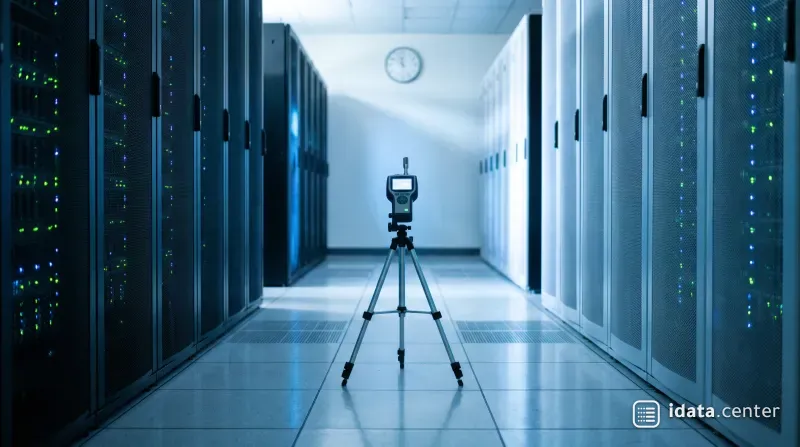
Take the ISO 14644-1 reading after cleaning has finished, the room has been tidied, and the cooling system has had time to clear the dust that the work stirred up. Record which occupancy state the room was in, because the same room gives different results empty and busy.
A reading taken while the last tiles are going back down only measures the cleaning itself. A reading taken a week later measures whatever happened in that week. The useful window is in between.
What are the three occupancy states in ISO 14644-1?
ISO 14644-1:2015 defines three states. Every classification must say which one applies.
|
State |
What it means |
In a data hall |
|
As-built |
Room complete, services connected and working, no equipment and no people |
A new hall before IT equipment is installed |
|
At-rest |
Room complete, equipment installed and running as agreed, no people present |
A live hall with nobody working inside |
|
Operational |
Room working in its normal way, with the agreed number of people |
A live hall during normal work |
In practice, a live data hall is almost never at-rest in the cleanroom sense, because servers and cooling run all the time. What changes between at-rest and operational is the people: technicians walking, lifting tiles and opening racks.
When should you take the reading?
1. After cleaning and stabilization
Cleaning lifts fine dust into the air. The cooling units and the room's filtration need time to remove it before the air reflects the real condition of the room.
As a field practice, wait 30 minutes to 2 hours after the last cleaning activity, depending on the size of the room and how quickly its cooling system turns over the air.
2. At-rest, for the baseline
With cleaning finished and nobody inside the room, the reading shows the baseline cleanliness the room can hold with equipment running. This is the most repeatable reading, and the one to compare from one cleaning visit to the next.
3. Operational, for ongoing monitoring
During normal work, the reading shows what the equipment actually breathes day to day. It is the better test for ongoing compliance, because it includes the effect of people, doors and maintenance work.
Before you start the test
- Confirm that all cleaning, tile work and rack work has finished, and equipment and bins have left the room.
- Check that cooling units are running normally and no doors are propped open.
- Agree the occupancy state with the client and write it on the test sheet.
- Use the correct number of sample locations and a calibrated particle counter.
- Sample at least 2 litres for at least 1 minute at every location, as ISO 14644-1:2015 requires.
Data halls are normally tested against ISO Class 8, the level the ASHRAE TC 9.9 guidelines set for data centers. The limits are in ISO 14644 cleanroom classes.
What should the test report be called?
The test shows that the air met ISO Class 8 at the time of the test, in the stated occupancy state. It does not mean the facility is "ISO certified". Certification is a formal process carried out by accredited bodies, and an air test by a cleaning or testing team is not that.
Clear names for the document are:
- Cleaning and air cleanliness test report
- Report of conformity with ISO 14644-1 Class 8
- ISO 14644-1 classification test report
Whatever the title, the report should state the date, the occupancy state, the class and particle sizes, the number and positions of the locations, the counter's calibration certificate, and the result at every location.
Timing and the type of cleaning
After post-construction and deep cleaning, a test is part of closing the job. After maintenance cleaning, a periodic test shows whether the routine is holding the room at the target class. The scope of each type is in types of data center cleaning.
Test when the dust from the work has cleared, write down the occupancy state and name the report honestly. Those three habits make your results comparable and your reports hard to question.
Frequently asked questions
When should you take the ISO 14644-1 reading after cleaning?
What are the three occupancy states defined in ISO 14644-1?
What does an at-rest reading measure in a data center?
What particle counter sampling requirements apply under ISO 14644-1:2015?
What ISO class are data halls normally tested against?
Subscribe to new articles
Get new articles by email. No spam, unsubscribe any time.
© Ashraf Almuhtaseb | idata.center. Short quotes are welcome with credit and a link to this article. Republishing the full article requires written permission.