The Critical Role of A-Type Ladders and Scissor Lifts in Data Centers
Learn the strategic use of A-type ladders and scissor lifts for data center cleaning. Protect workers and vital IT infrastructure with proper safety protocols.
Key takeaways
- Using straight or extension ladders in data centers is prohibited due to the risk of tipping against server racks and damaging IT infrastructure.
- A-Type safety ladders provide a self-supporting, stable base for cleaning tasks performed at heights of approximately 5 to 7 meters.
- Compact electric scissor lifts are the standard solution for safe access to high areas above 8 meters in data center environments.
- Technicians working on A-Type ladders or inside scissor lifts must wear a full-body safety harness attached to a secure anchor point.
Climbing Safely: A-Type Ladders and Scissor Lifts in Data Center Cleaning
In a high-density data center, cleaning reaches from the floor to the overhead cable trays. Getting to those heights, whether to dust server surfaces, clean vents or reach light fittings, needs the right access equipment and strict safety rules. Unstable or unsuitable equipment puts the technician at risk of injury and puts live IT equipment at risk too.
This article explains the safe use of two essential tools: the A-type safety ladder for low and medium heights, and the scissor lift for high areas. In a data center, people safety and asset protection cannot be separated.
Why are straight ladders a risk in a data center?
A straight ladder or extension ladder inside a data center is an unacceptable risk. Narrow aisles, dense cabling and live equipment make the space unusually hazardous.
- Instability and tipping: A straight ladder must lean against something. In a server aisle, the only surfaces are racks full of live equipment. Leaning a ladder on a rack can damage parts, move cables and, worst of all, let the ladder slip or tip if the rack moves or the ladder feet slide on a floor tile.
- Fall hazard: A technician on a straight ladder, reaching out to clean, has a high centre of gravity. A slip or sudden loss of balance can cause a serious fall. The impact can injure the technician and set off a chain reaction: damaged cabinets, cut network cables or a triggered emergency power-off switch.
- Limited working space: A straight ladder has no platform for tools, so the technician carries equipment while trying to keep balance.
The A-type safety ladder: a stable base for lower heights
For work within the ladder's rated working height, such as cleaning the front and back of network cabinets, vents or the lower parts of walls, an A-type ladder (stepladder) is the correct and safe choice.
- Stability: The self-supporting A-frame does not lean on any equipment. It stands freely on the data center floor.
- Safe work platform: The top platform holds a HEPA vacuum hose or cleaning tools, so the technician can work with both hands where possible. See HEPA vacuums inside data centers.
- A spotter, every time: One simple rule doubles safety: always use a spotter.
What does the spotter do?
- Secures the ladder by standing at the base with feet on the bottom rung to stop any movement.
- Steadies the ladder, especially while the technician climbs, comes down or reaches.
- Passes tools up and down, so the technician never climbs with their hands full.
- Watches the aisle for other people or equipment and warns the technician at the top.
The scissor lift: safe access to high areas
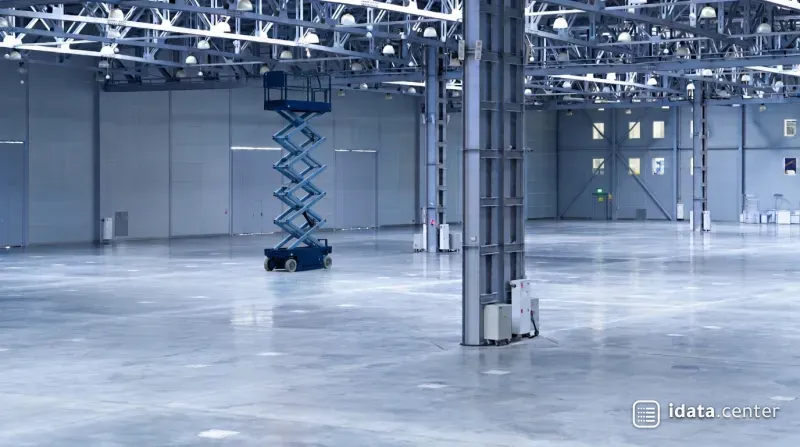
For areas beyond safe ladder reach, such as high ceilings, overhead cable trays, air ducts or light fittings, a compact electric scissor lift is the standard solution.
Scissor lifts are mobile elevating work platforms (MEWPs). In the United States their design, safe use and training are covered by the ANSI/SAIA A92 standards for MEWPs, including A92.22 on safe use and A92.24 on training.
- Safety and precision: The lift gives a large, stable, guarded platform that rises and lowers smoothly, so the technician can focus on cleaning, not on balance.
- Fits tight spaces: Narrow-aisle models are made to move along standard hot and cold aisles without touching equipment.
- Two-person operation: Running a lift in a data center is a two-person job.
Who does what on a lift?
- Trained operator: Only staff trained on that specific lift model should use the controls. They move the lift smoothly, make sure the platform path is clear before moving and know where the emergency controls are.
- Ground spotter: Walks beside the lift as it moves, watches for overhead obstacles such as sprinklers and cables, keeps the floor path clear of cable loops and tile edges, and stays in contact with the operator at all times.
Important note: Data centers have many overhead systems, such as false ceilings, light fittings and cable trays, so space for a lift is often tight. Discuss this with the data center manager before the job, to make sure the cleaning tools can reach the highest point needed without putting safety at risk. For inspecting very high areas without climbing, see handheld inspection cameras in data centers.
Fall protection and safety harnesses
Fall protection applies on both ladders and lifts.
- On an A-type ladder: Although the design is stable, wear a safety harness attached to a secure anchor point where one is available, especially for long or tiring work.
- In a scissor lift: This is a firm requirement. Technicians on the platform must wear a full-body harness with a lanyard attached to the anchor point the manufacturer specifies inside the platform. It stops the technician from falling or being thrown over the guardrail if the lift malfunctions or moves suddenly.
Safety as part of the cleaning method
Data center cleaning always involves working at height. Treating it with anything less than the highest safety standards is an operational risk.
By requiring A-type ladders, operator-controlled scissor lifts, harnesses at height and a spotter for every climb, facility managers and service providers protect their people and, at the same time, the IT infrastructure that a single preventable accident could damage.
In a data center, the right access equipment used with strict rules is one of the foundations of safe work and a basic duty of care.
Frequently asked questions
Why are straight ladders considered an unacceptable risk in a data center?
What heights are A-Type ladders used for in data center cleaning?
What is the role of a spotter when using an A-Type ladder?
When should a compact electric scissor lift be used?
Are safety harnesses mandatory when using access equipment?
Subscribe to new articles
Get new articles by email. No spam, unsubscribe any time.
© Ashraf Almuhtaseb | idata.center. Short quotes are welcome with credit and a link to this article. Republishing the full article requires written permission.