What Can Affect the Data Center Cleaning Plan
There are many factors that may not be planned in advance before starting the cleaning process and that negatively affect the effectiveness and timing of cleaning
Key takeaways
- Most data center cleaning overruns stem from non-cleaning factors like unclear scopes, conflicting works, and slow security procedures.
- Cleaning teams must agree on approved power outlets in advance and should never use rack PDUs to power their equipment.
- Dusty works must conclude before cleaning, and ASHRAE TC 9.9 advises unboxing equipment outside the data center to prevent dust fouling.
- Project acceptance terms must be set at the start, including a walk-through, photo records if allowed, and a final ISO 14644-1 test.
What Can Affect a Data Center Cleaning Plan?
Most data center cleaning projects that overrun do so for reasons that have nothing to do with cleaning. An unclear scope, other works in the same hall, missing power outlets, short working windows and slow security procedures can double the time a team spends on site while the actual work stands still.
Each of these can be solved before the first day. The eight points below are the ones that come up again and again, with what to agree in advance.
Why does planning matter so much?
A data hall is a live, secured space. Every hour lost to waiting is an hour the team is inside a critical room without producing anything, and an hour the site staff spend escorting them. Poor planning also pushes teams to rush the last days, which is when mistakes happen.
What are the eight factors that affect the plan?
1. Lack of clarity in the work plan
Without a fixed schedule and a clear working arrangement between the building's site manager, the contractor's project manager and the technicians, the scope keeps changing and the work is delayed.
Agree in advance: the type of cleaning, the areas and racks in scope, the daily sequence and one named contact on each side. The types are defined in types of data center cleaning.
2. Conflict with other works
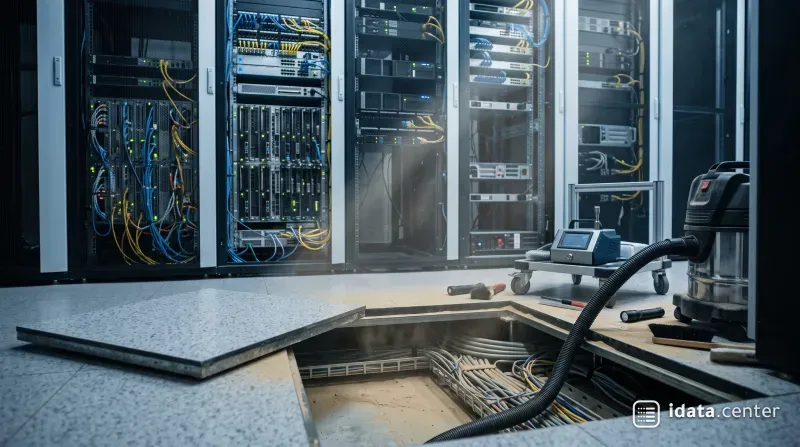
Maintenance or the installation of network equipment and cabinets at unplanned times stops the technicians and slows the cleaning. Cleaning works best with as few other activities in the hall as possible, apart from necessary or emergency maintenance.
Agree in advance: a works calendar that shows all contractors, and a rule that dusty work such as drilling inside data centers finishes before cleaning starts, not after.
3. Lack of power sources
There are often too few outlets for cleaning equipment, or no industrial sockets that match the team's plugs.
Agree in advance: which outlets the team may use (never rack PDUs), the socket type and the load of each machine. Bring adapters and extension leads that meet site rules.
4. Limited working hours
Permitted hours on site are sometimes too short for the scope. Flexibility helps, especially outside the site's peak hours for essential operations.
Agree in advance: the daily working window, night or weekend options and how many days the scope really needs within that window.
5. No secure storage room
Without a secure room for cleaning equipment, or with a room far outside the building, the team loses time on every entry and exit inspection.
Agree in advance: a lockable storage room close to the data hall, outside the white space. It is also where cartons and packaging are opened. ASHRAE advises unboxing new equipment outside the data center, because fibrous dust from cardboard can foul heat sinks (ASHRAE TC 9.9 guidelines).
6. Long entry and exit procedures
Daily permits and long inspections of people and equipment delay the start and end of each day.
Agree in advance: permits for the whole project period where possible, a pre-approved equipment list and a fixed time for daily inspection.
7. Little familiarity with site procedures
Technicians who do not know the site's safety and security rules end up in conflict with security staff and safety managers.
Agree in advance: a site induction on day one, covering safety, security, emergency exits, restricted areas and the dress code described in what to wear for technical cleaning.
8. Security arrangements
Without prior coordination with security, technicians may be stopped from entering or from completing tasks, or it may be unclear what they are allowed to do. This matters most in high-security data centers.
Agree in advance: a written list of what technicians may and may not touch, which racks may be opened, whether photos are allowed and who escorts the team.
Pre-start checklist
|
Item |
Owner |
Done |
|
Scope, cleaning type and daily sequence signed |
Site manager and contractor |
☐ |
|
Works calendar shared, no dusty work during cleaning |
Site manager |
☐ |
|
Power outlets and socket types confirmed |
Facilities |
☐ |
|
Working hours and days agreed |
Site manager |
☐ |
|
Secure storage room assigned |
Facilities |
☐ |
|
Permits and equipment list approved |
Security |
☐ |
|
Site induction booked for day one |
Safety manager |
☐ |
|
Allowed and prohibited actions written down |
Security and site manager |
☐ |
|
Final ISO 14644-1 test agreed |
Site manager and contractor |
☐ |
Note: adjust the owners in the table to the roles you usually deal with on site.
How do you close the project?
Agree at the start how the job will be accepted: a walk-through of the areas, a photo record if security allows it, and an ISO 14644-1 test at the right time, as explained in when to take the ISO 14644 reading.
Advance coordination, a clear method and a shared understanding between project managers, technicians, security and safety staff are what keep a data center cleaning project on time. Settle these eight points before day one, and the team can spend its hours on the work itself.
Frequently asked questions
Why do data center cleaning projects often overrun?
How can conflicting work affect data center cleaning?
Why is a secure storage room important for cleaning teams?
What should be agreed upon regarding power sources before cleaning starts?
How can security procedures delay a cleaning project?
Subscribe to new articles
Get new articles by email. No spam, unsubscribe any time.
© Ashraf Almuhtaseb | idata.center. Short quotes are welcome with credit and a link to this article. Republishing the full article requires written permission.